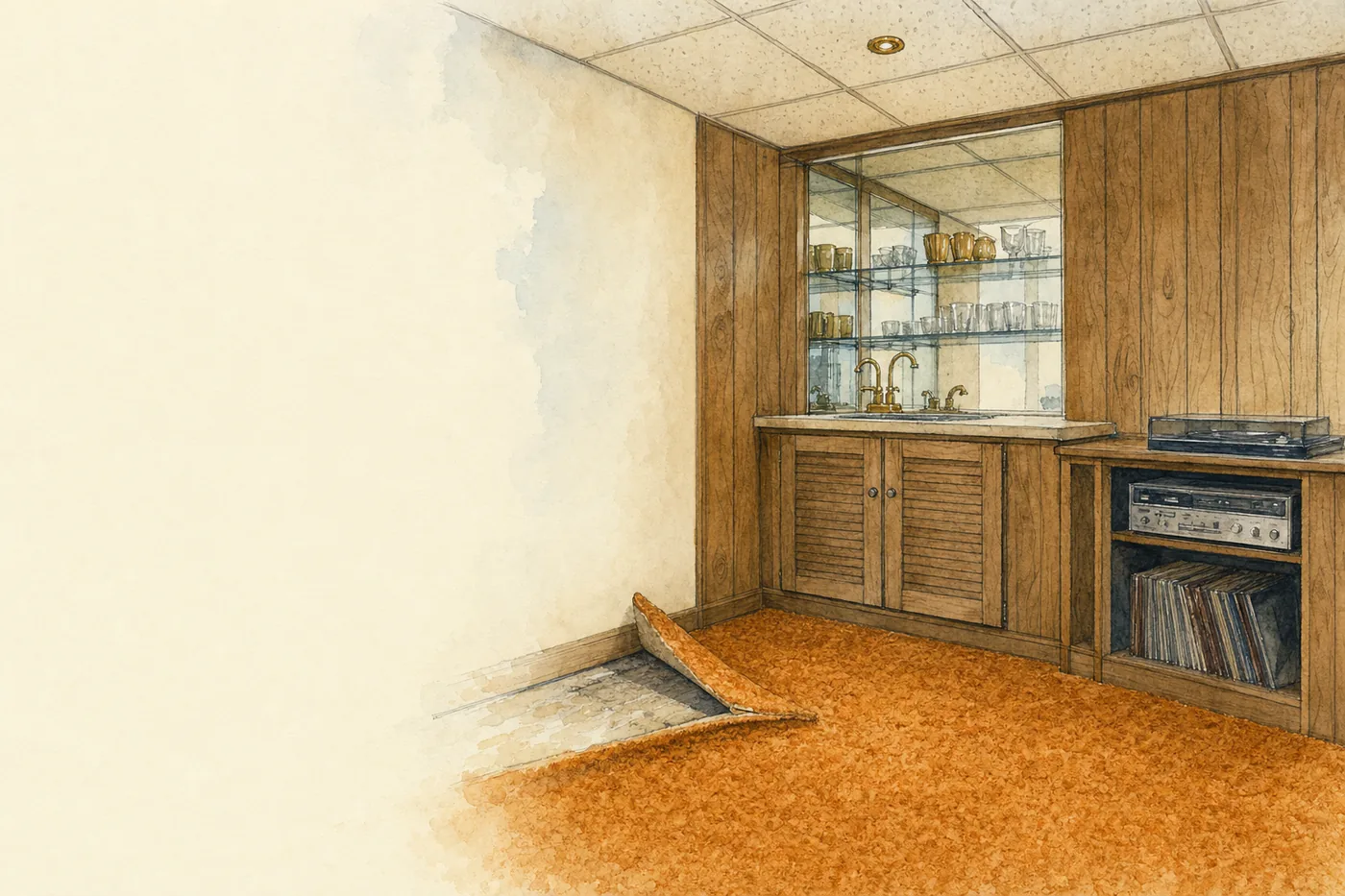
Open the basement door in a lot of Acadia, Southwood, Palliser, Braeside or Woodbine split-levels and you walk straight into 1974. Orange or avocado shag carpet. A wet bar with a mirrored backsplash. Wood paneling floor to ceiling, sometimes over top of more wood paneling someone added later. A drop ceiling hiding who knows what. For a certain generation of Calgarian, that room is not dated. That room is their childhood.
These communities went up fast in the boom years of the sixties and seventies, when the city was spreading south and families wanted more room than the older inner-city bungalows gave them. The split-level and bi-level designs that filled those streets were a genuine idea, not just a style. Put the family room down a half flight, away from the formal living room up top. Give the kids a space to be loud that was not the same space the adults used for company. The wet bar and the paneling were not an afterthought. They were the point of the room.
I have a soft spot for a good one. A proper wet bar with a built-in stereo cabinet is a piece of furniture nobody makes anymore, not because nobody could, but because nobody would pay for it. From working alongside inspectors and buyers over the years, I have noticed the basements that had never been touched were often the most honest houses on the street. Nobody had opened a wall to hide a problem. Nobody had painted over something they should have fixed.
What's behind the paneling
The nostalgia is real, but so is the question every buyer eventually asks: what does it cost to bring this basement into this decade. The paneling and the carpet are the cheap part. Pull them out over a weekend and you have made no real progress, because what matters is what is behind them.
Houses from that era in southwest Calgary often still have original wiring and original insulation behind that paneling, sometimes original flooring under the shag that nobody has looked at in fifty years. Some have vinyl floor tile from an age when a different kind of tile was common. None of that is a reason to walk away from the house. It is a reason to get a licensed inspector who knows pre-1980 construction to go through it properly before you commit to a number for the renovation, not after.
I always tell buyers the same thing: do not price the reno off what the basement looks like. Price it off what you cannot see yet. A basement that looks rough but has nothing hiding behind the paneling is a cheaper job than a basement that looks fine and has a wiring panel decades past its service life waiting for you.
The part that does not need fixing
Here is what I would not touch in a hurry: the bones. These split-levels sit on good-sized lots, often with mature trees that took forty years to get that big and cannot be bought at any price on a new build. The layout that separated kids from adults in 1974 still does the same job today, maybe better, now that everyone is on a screen in a different room. The lot and the floor plan are the terroir. The shag carpet is just the finish, and finishes can be changed.
What I see buyers get wrong is falling for one extreme or the other. Either they walk out because the basement looks like a museum, which costs them a good house on a good street. Or they fall in love with the wet bar and forget to ask what is behind the wall, which costs them a renovation budget they did not plan for. The honest answer sits in the middle. The basement is a cosmetic problem wrapped around a structural question, and you need to answer the structural question first.
If you are looking at one of these homes and trying to figure out whether the number makes sense once you add in a real basement renovation, I am happy to pull what comparable split-levels in these communities have actually sold for, finished and unfinished, so you are working from real numbers instead of a guess. And if the house is a serious contender, get your own inspector in before you fall further for that wet bar than the wiring can support. I am Rich Baldy with CIR Realty, and that basement has a story. Worth knowing which parts of it you are keeping.