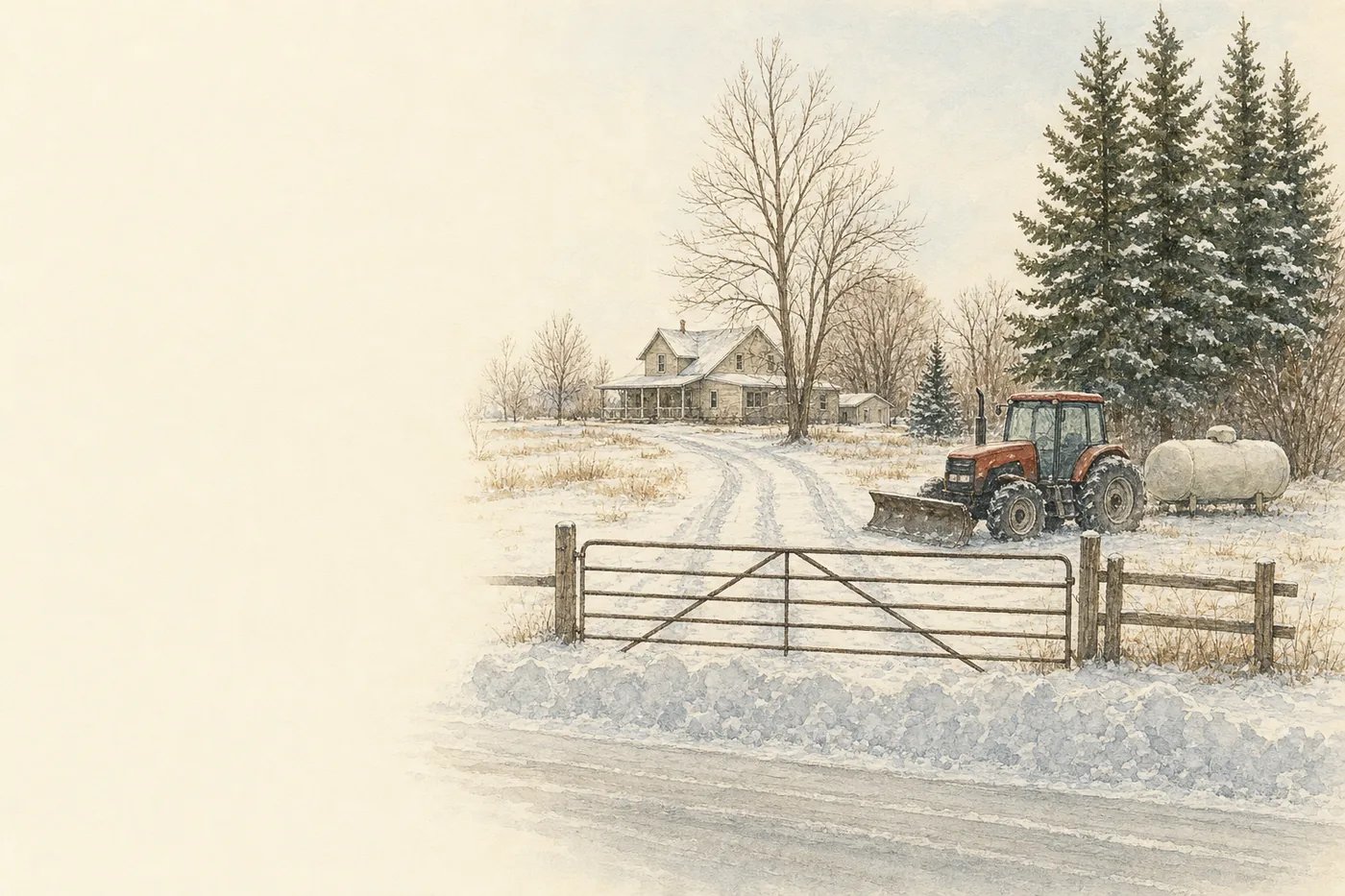
Most acreage shopping happens in warm weather. People drive west of the city on a Saturday, see the long driveway, the quiet, maybe a horse in a neighbour's field, and they picture themselves there. What they are picturing is July. The place they are actually buying also comes with January, and January is where acreage living gets real.
Inside the city, snow removal is somebody else's problem until it is on your own sidewalk. Out past the city limits, the road allowance usually ends at your gate. The county or the municipal district plows the road. Nobody plows your driveway. If it is three hundred metres long and it snows overnight, you are out there with a tractor or a blade before work, every time, for the whole season. Some people love that. Some people find out the hard way that they do not.
Water and power are not background utilities anymore
In the city, water shows up at the tap and you barely think about it. On an acreage, water usually comes from a well, and a well needs a working pump, and a pump needs power. If the power goes out in a winter storm, which happens more often on rural lines than in the city, you do not just lose your lights. You can lose your water at the same time. A generator is not a luxury item out there, it is closer to a requirement, and it is one more thing to budget, maintain and remember to start.
Septic systems ask for attention too. They do not stop working because it is cold, but the ground around the field does freeze, and a system that was already struggling in the fall does not get easier to service once the frost sets in. Pumping trucks have a season of their own, and the slow month to book one is usually not January.
Heat is something you order, not something that just arrives
A lot of acreage homes run on propane rather than city gas. That means a tank on the property and a delivery schedule, not a pipe that never runs dry. Letting the tank run low in a cold snap is a mistake I hear about more than once a winter, always from someone who assumed it worked like a city furnace. It does not. You watch the level and you order ahead.
The drive is the other half of the decision
Commute times west of the city sound reasonable on a clear September evening. They stop sounding reasonable on a night with blowing snow and a highway down to one lane. Before buying, it is worth driving the actual route at the time of day you would really be doing it, in the kind of weather you would really be doing it in. A twenty-five minute drive on Google Maps and a twenty-five minute drive in a January whiteout are not the same trip.
What buyers ask, and what I wish they asked more
Most people touring acreages ask about the view, the shop, the barn, how many acres are fenced. Those are fair questions. The ones I wish I heard more often are about the well's output, the septic system's age, and how the property handled the last bad winter before this one. Those are not questions a realtor can answer from the driveway. A qualified well contractor and a septic inspector can, and on a rural property they are worth hiring before you remove conditions, the same way you would hire a home inspector on anything you are buying in the city.
None of this is meant to talk anyone out of acreage life. I like what it offers. I just think the decision goes better when it is made in January conditions, even if you are standing there in September doing the imagining. If you are weighing an acreage against something closer in, or trying to work out what a property like that would actually cost you month to month, I am happy to talk it through. I am Rich Baldy with CIR Realty, and that conversation is worth having before the drive becomes your daily life, not after.
